Plants, berries and trees
Profiles connect recognition features, habitat, season, edible parts and documented Newfoundland names or status.
A full-colour Newfoundland field guide
A Field Guide to Newfoundland Wild Foods
The field guide that brings Newfoundland’s land and shore to one table.
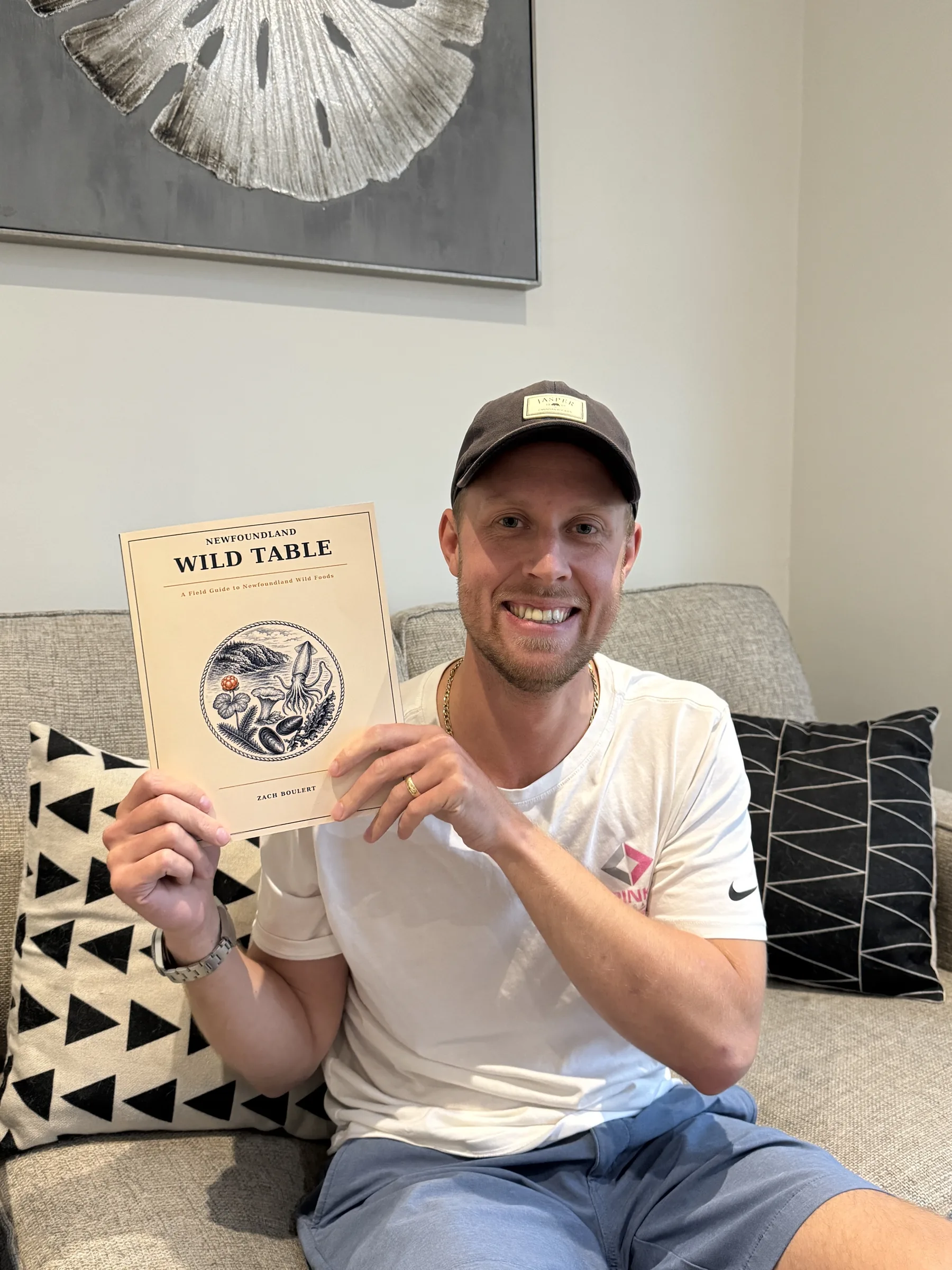
The story behind the book
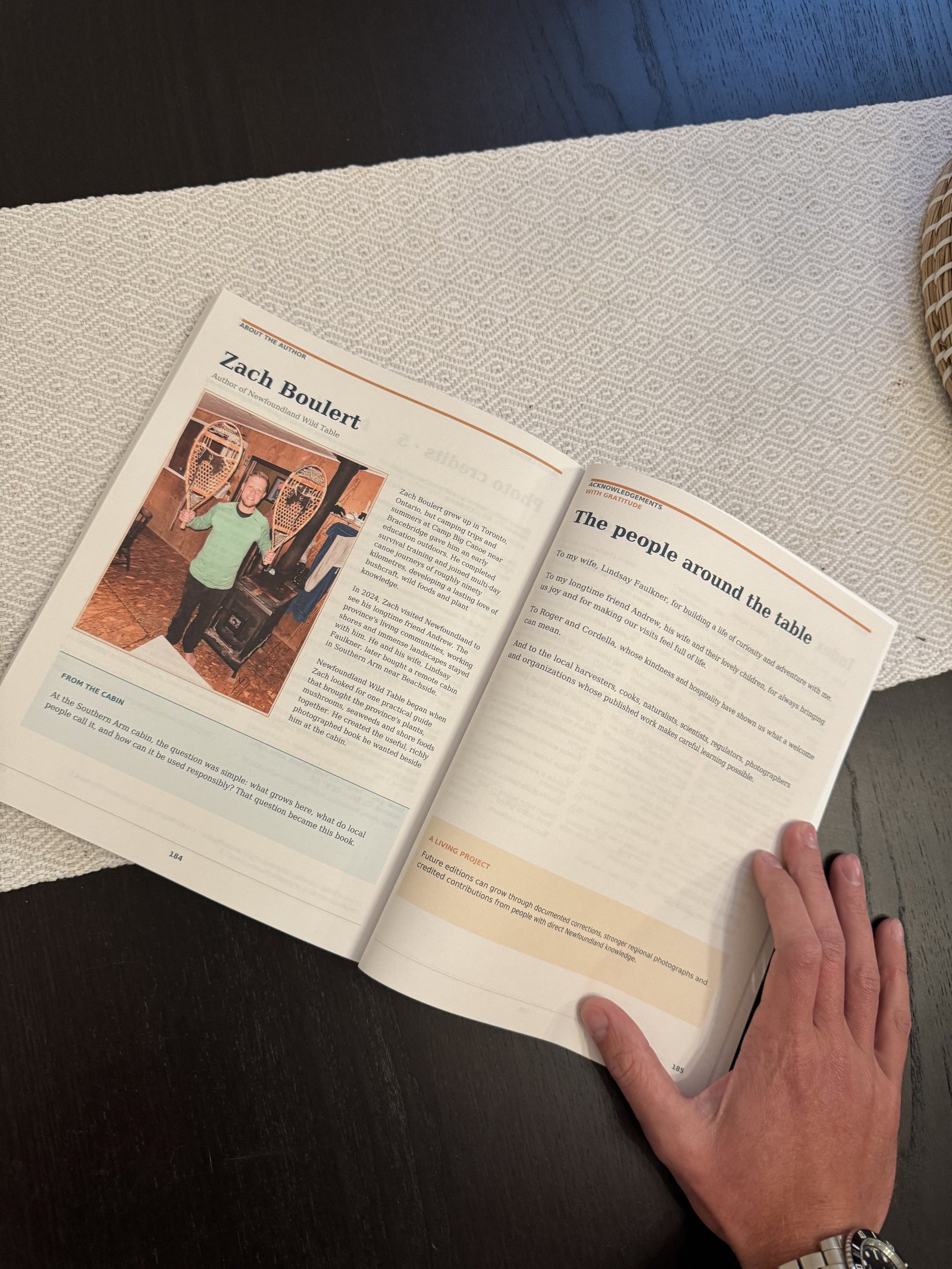
Zach Boulert grew up in Toronto, Ontario, but camping trips and summers at Camp Big Canoe near Bracebridge gave him an early education outdoors. He completed survival training and joined multi-day canoe journeys of roughly thirty kilometres, developing a lasting interest in bushcraft, wild foods and plant knowledge.
In 2024, Zach travelled to Newfoundland to see his longtime friend Andrew. The province’s living communities, working shores and immense landscapes stayed with him. Zach and his wife, Lindsay Faulkner, later bought a remote cabin in Southern Arm near Beachside, Newfoundland.
Time at the cabin brought a practical question into focus. Zach wanted to understand what grew nearby, what local people called it, how land and shore foods differed, and what responsible preparation required. He looked for one richly photographed guide that could sit beside him at the cabin and bring those subjects together.
That search became Newfoundland Wild Table: a Newfoundland foraging book covering plants, berries, trees, mushrooms, seaweeds, shellfish, squid and other shore foods, followed by practical ways to bring carefully identified ingredients into the kitchen.
“At the Southern Arm cabin, the question was simple: what grows here, what do local people call it, and how can it be used responsibly? That question became this book.”
What the book covers
Foraging in Newfoundland can lead from berry ground and forest edges to seaweed, shellfish and squid along the working shore. The book organizes that range into five clear parts, giving each subject enough room to explain what readers should notice, what preparation may be required and where the information comes from.
Profiles connect recognition features, habitat, season, edible parts and documented Newfoundland names or status.
Whole-organism features, confusing alternatives, required preparation and clear source trails support careful comparison.
Coastal profiles bring together recognition, harvest context and practical preparation without treating every shoreline as the same.
Shellfish, squid and other Newfoundland shore foods are presented with the current-condition and handling questions that matter.
Thirty traditional-style and Newfoundland-inspired recipes move from a confirmed ingredient to a practical meal.
Inside the first edition
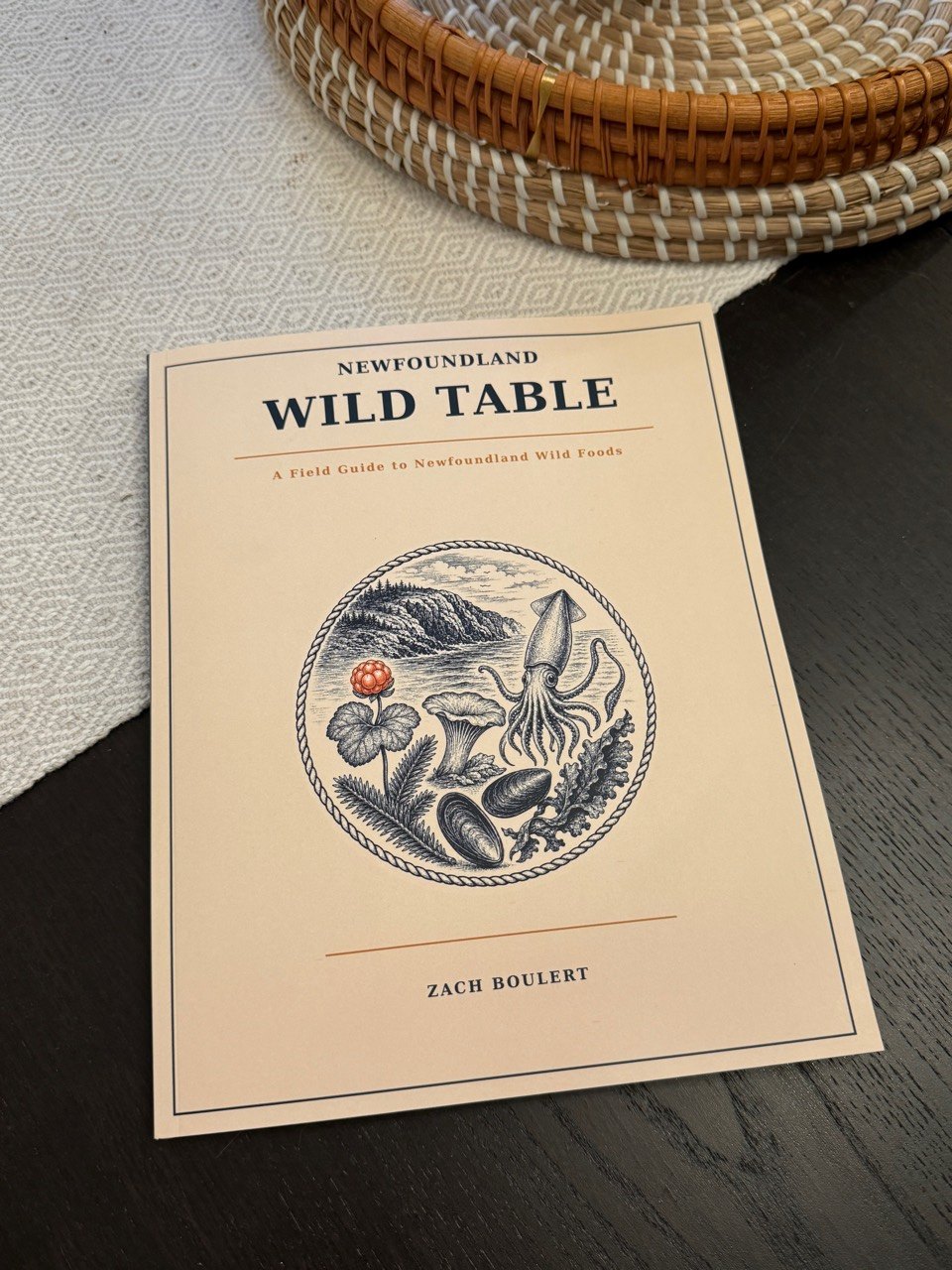
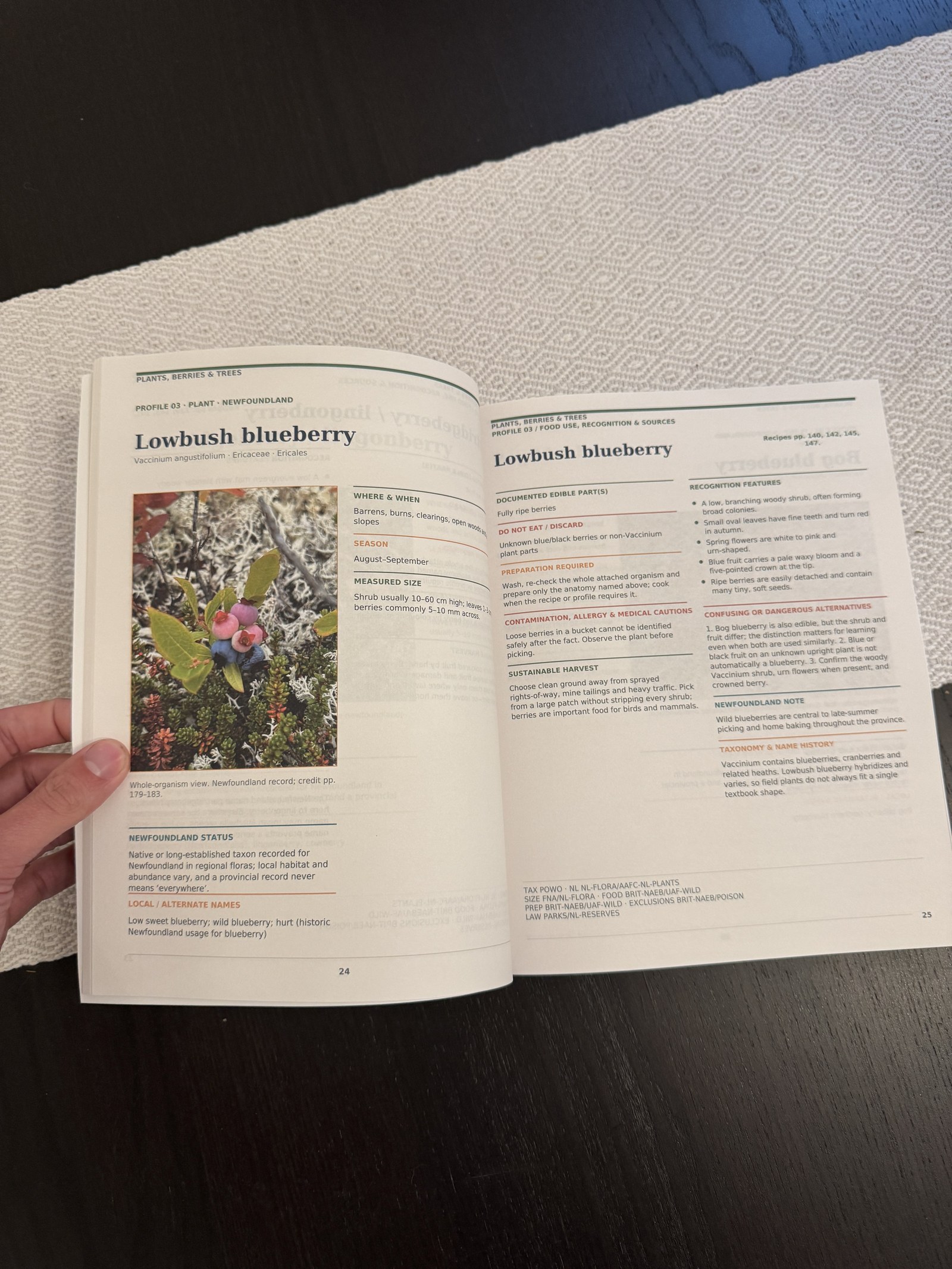
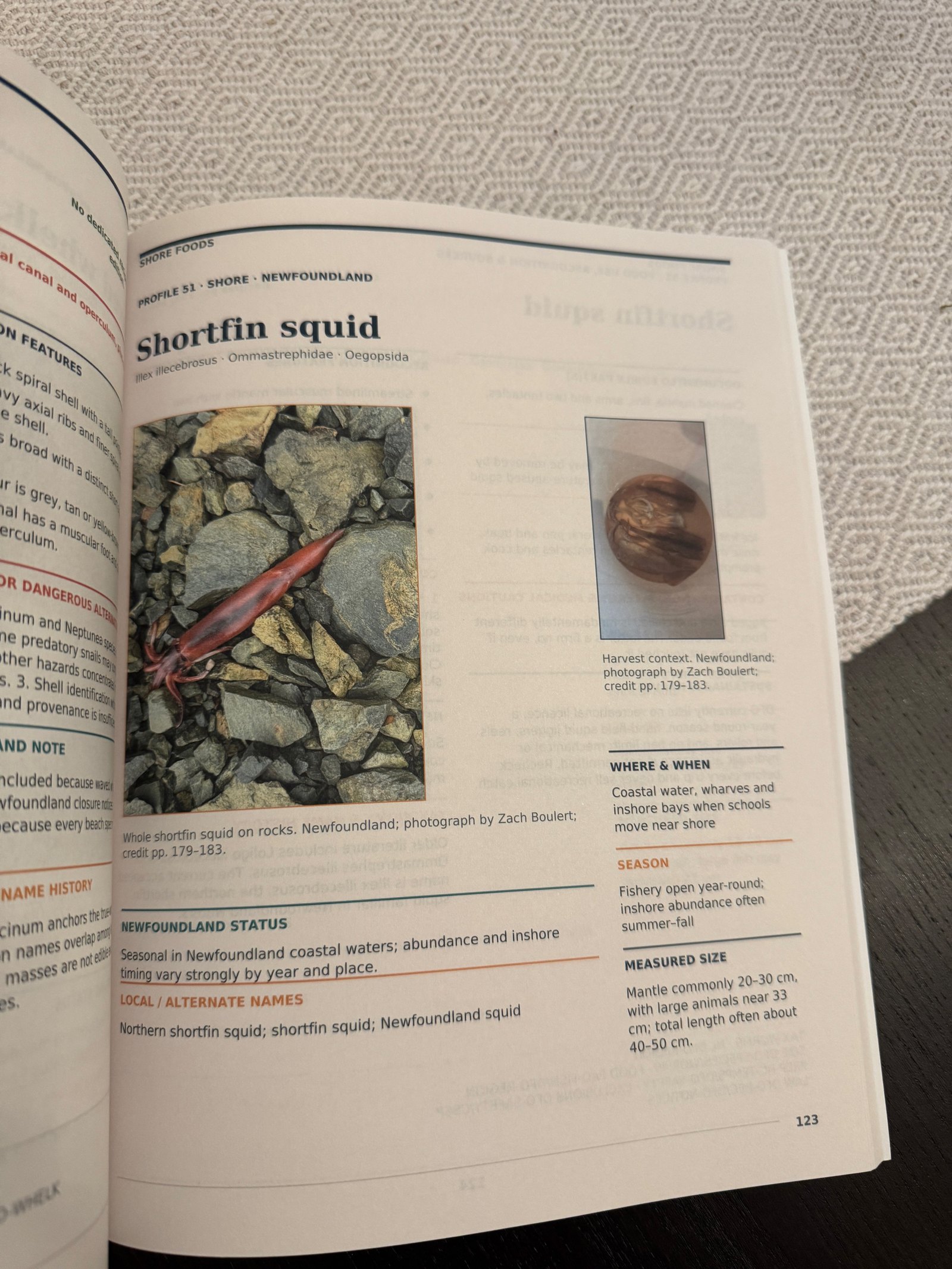
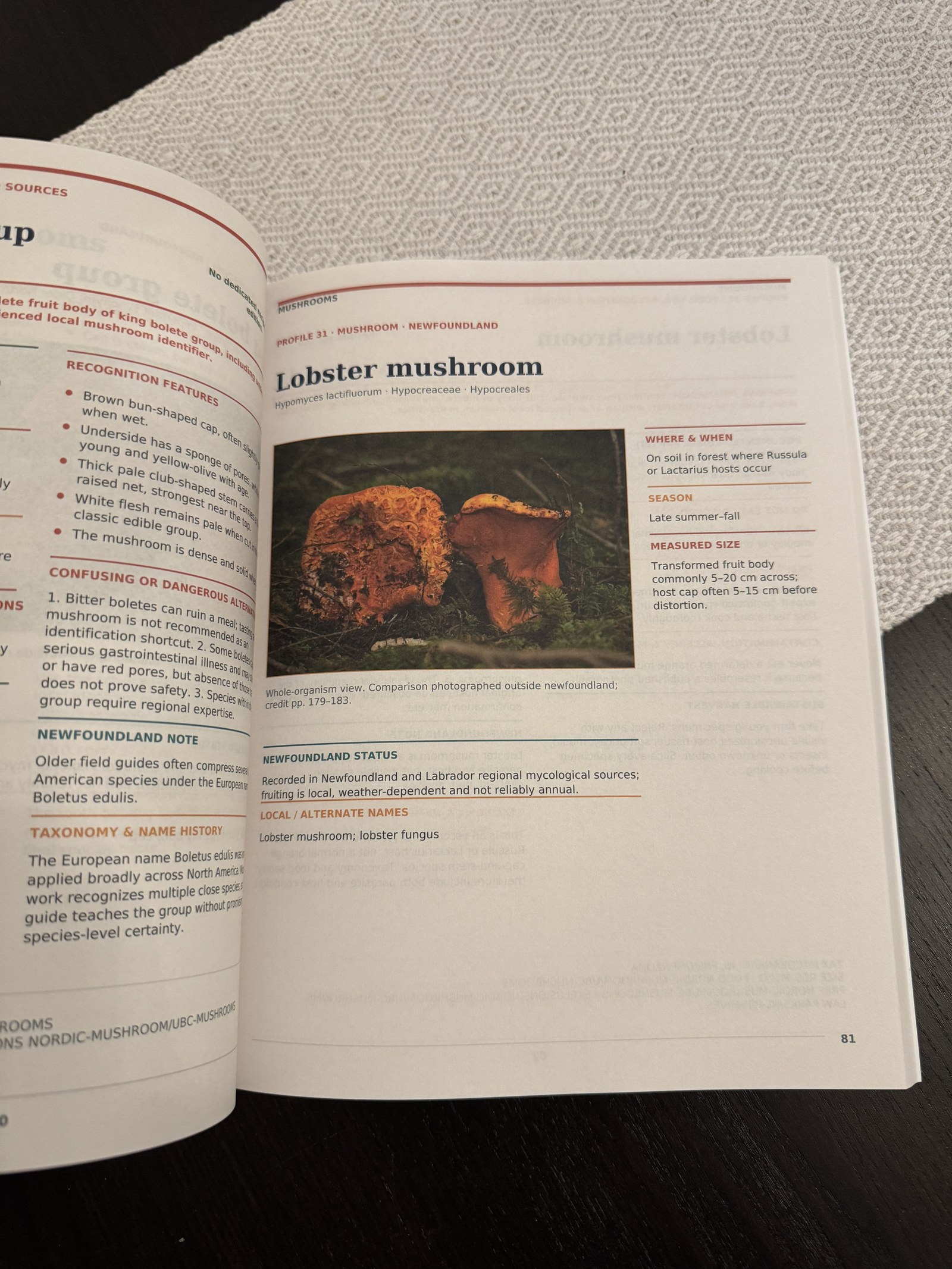
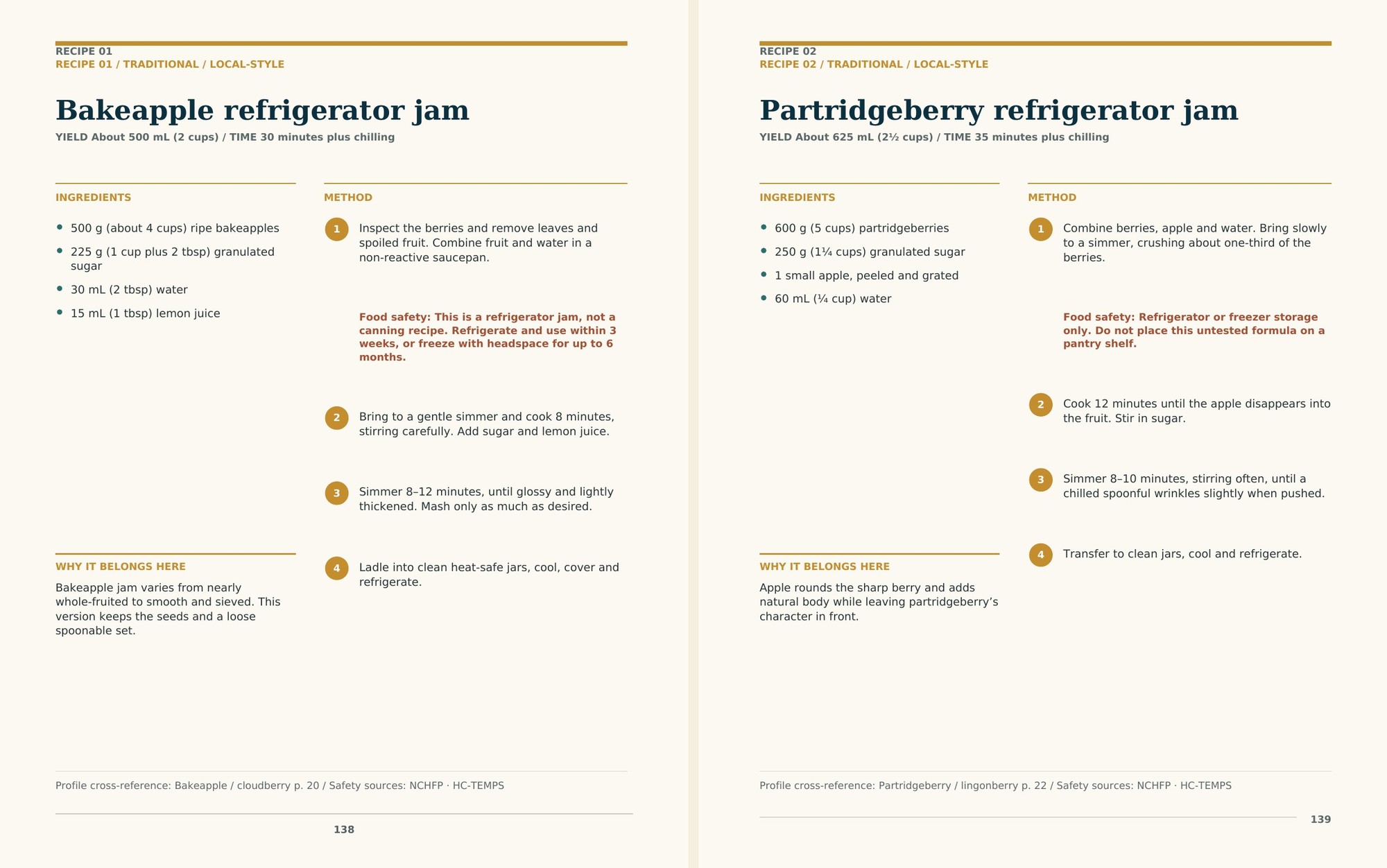
The complete covers and spreads are shown at their natural proportions. Open any image to examine the field-guide layout without reproducing enough of the manuscript to replace the book.
The profile system
Each of the 52 wild-food profiles follows a consistent two-page structure. The whole organism, its habitat and the season come first. From there, readers can compare measured size, documented edible parts, required preparation, lookalikes or confusing alternatives, responsible harvesting guidance and the sources behind each claim.
The Newfoundland status and local-name sections add context where the manuscript has reliable documentation. That distinction matters: a provincial record does not mean a plant or mushroom appears everywhere, and a familiar local name may be used differently from one place to another.
The source codes at the foot of each profile connect taxonomy, occurrence, food use, preparation and current rules to a compact bibliography. The result is not just a collection of attractive photographs. It is a practical Newfoundland field guide that shows readers what evidence to compare and where to continue their research.

The Newfoundland wild kitchen
The book moves from recognition and responsible harvesting into practical preparation. Thirty traditional-style and Newfoundland-inspired recipes show how carefully identified ingredients can become part of a meal without separating the recipe from the handling and preparation that comes first.
The collection includes Bakeapple refrigerator jam, Blueberry duff, Mussel chowder with savoury, Chanterelle toutons and Dulse oatcakes, alongside Fast-fried squid rings and Pan-fried capelin. Each recipe is connected back to the relevant profile so readers can move between the ingredient and the kitchen method.
For readers interested in Newfoundland wild-food recipes, this section gives the guide a practical second life: something to consult when learning outdoors and something to return to when the ingredients reach the table.

The author
Zach’s outdoor education began well before Newfoundland Wild Table. Growing up in Toronto, he spent camping trips and summers at Camp Big Canoe near Bracebridge learning outdoors. Survival training and multi-day Ontario canoe journeys of roughly thirty kilometres deepened his interest in bushcraft, wild foods and plant knowledge.
His connection to Newfoundland began in 2024, when he travelled east to visit his longtime friend Andrew. Zach returned home thinking about the communities, working shores and immense landscapes he had encountered. He and his wife, Lindsay Faulkner, later bought a remote cabin in Southern Arm near Beachside.
At the cabin, Zach wanted one practical, carefully sourced book that could help him learn about Newfoundland’s plants, mushrooms, seaweeds and shore foods—and then use those ingredients in the kitchen. He wrote and photographed the guide he wanted beside him there.
First Edition, 2026
A Field Guide to Newfoundland Wild Foods by Zach Boulert.
Buy on Amazon CanadaPress, shops and events
Use this form for media interviews, book features, retail stocking inquiries, events and collaborations. Share what you have in mind and Zach will follow up directly.
Questions about the book
Newfoundland Wild Table is a 192-page full-colour Newfoundland foraging book by Zach Boulert. It brings together 52 wild-food profiles, careful recognition and preparation guidance, documented source trails and 30 recipes.
The book covers plants, berries and trees; mushrooms; seaweeds; and shore foods including shellfish and squid. Individual profiles identify documented edible parts, required preparation, confusing alternatives, habitat, season and Newfoundland context where reliable information is available.
It is both a field guide and a practical kitchen companion. The first sections help readers compare wild foods carefully, while the Newfoundland wild kitchen contains 30 traditional-style and Newfoundland-inspired recipes connected to the featured ingredients.
The idea took shape at Zach and Lindsay’s remote cabin in Southern Arm near Beachside, Newfoundland. Zach wanted one useful guide that brought the plants, mushrooms, seaweeds and shore foods he was learning about into a single, carefully sourced book.
The full-colour paperback is available through Amazon Canada. Purchases are completed on Amazon rather than through zachboulert.com.

The first edition
Explore 52 wild-food profiles and 30 recipes in the 192-page full-colour paperback.
Buy on Amazon CanadaPhotographs of the physical book were supplied by Zach Boulert for use on this official book page. The shortfin squid photographs visible in the interior preview were photographed by Zach Boulert in Southern Arm, Newfoundland and Labrador, in August 2026.
The recipe preview was rendered from pages 138–139 of the final manuscript. Text, recipes and editorial design are © 2026 Zach Boulert. The web preview was resized and compressed.
These credits describe the third-party identification images visible in the selected interior previews and do not imply endorsement by their creators.